Azure Landing Zone Architecture
Designed a secure, scalable Azure foundation aligned with Zero Trust principles, enterprise cloud governance, and production-ready operational standards.
Executive Summary
Built a centralized Azure landing zone using hub-spoke networking, Azure Firewall, private endpoints, and Infrastructure as Code to improve security, scalability, and operational consistency across environments.
Business Impact
30–50% Cost Reduction
Optimized cloud infrastructure through centralized governance and architecture standardization.
100% Infrastructure as Code
Achieved fully repeatable and version-controlled infrastructure deployments.
2–5x Faster Deployments
Reduced provisioning time through Terraform automation and reusable architecture patterns.
Improved Security Posture
Reduced attack surface using segmentation, private endpoints, and centralized inspection.
Problem Context & Challenges
The organization required a standardized cloud foundation to support multiple workloads, but existing environments lacked centralized governance, security consistency, and scalable operational patterns.
- • Inconsistent environment configurations
- • Flat network design with weak segmentation
- • Limited centralized visibility and control
- • Manual deployment overhead and configuration drift
Before vs After Architecture
Before
- • Flat network design
- • Publicly exposed workloads
- • No centralized firewall inspection
- • Manual provisioning processes
- • High configuration inconsistency
After
- • Hub-spoke network architecture
- • Centralized Azure Firewall
- • Private endpoints for workloads
- • Terraform-based automation
- • Standardized governance model
Architecture Overview
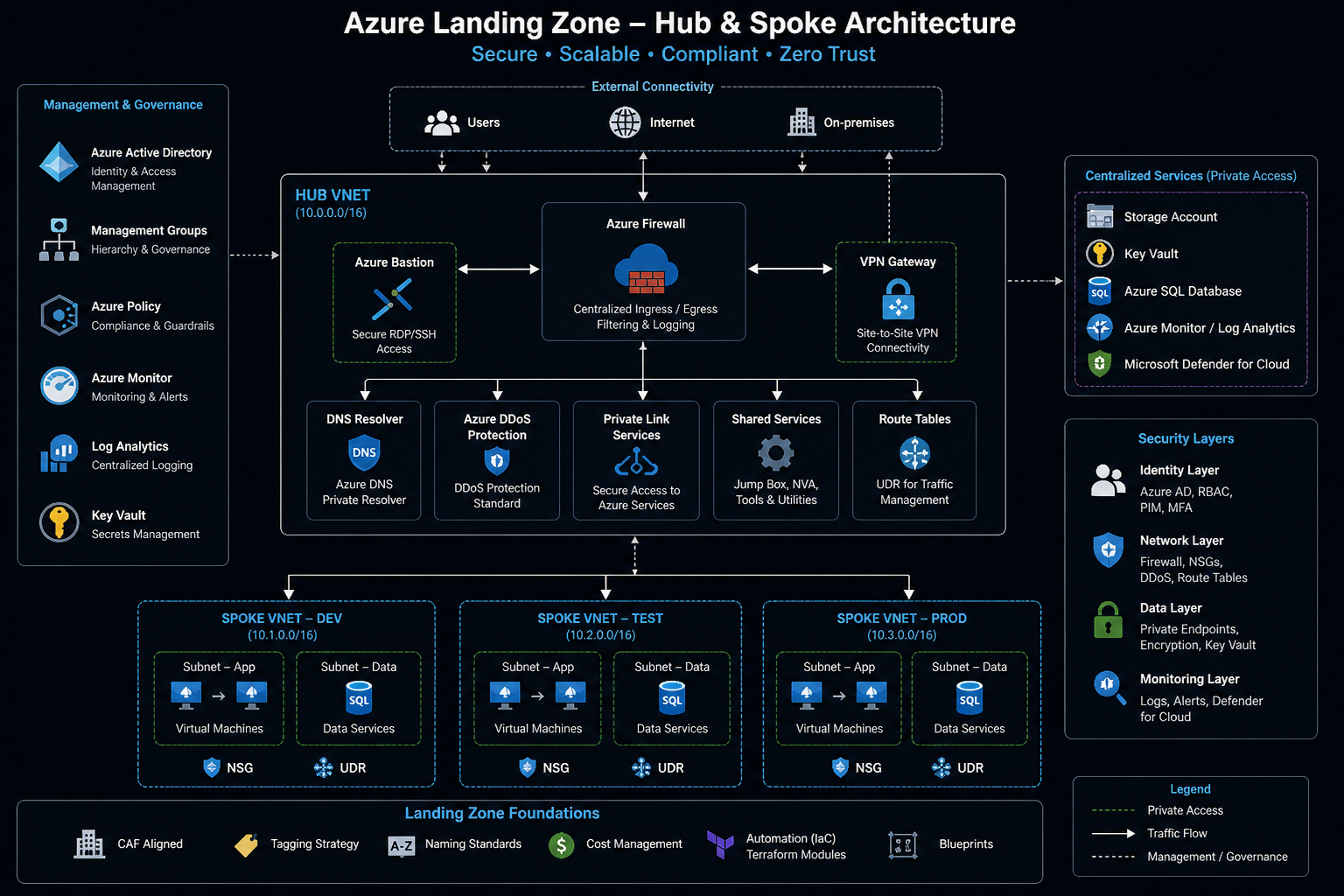
The landing zone architecture enforces centralized governance and Zero Trust security principles. All traffic flows through Azure Firewall while workloads remain isolated across spoke networks.
Architecture Decisions
Hub-and-Spoke Network
Selected to centralize traffic inspection, simplify governance, and enable scalable workload isolation.
Azure Firewall
Implemented as a centralized security control point for ingress, egress, and east-west traffic inspection.
Private Endpoints
Eliminated unnecessary public exposure of services and improved secure connectivity posture.
Security Model
Identity Security
Enforced least privilege access controls across cloud resources.
Network Segmentation
Restricted lateral movement using segmented workloads and NSGs.
Private Connectivity
Removed public access paths using private endpoints.
Centralized Inspection
All traffic inspected through Azure Firewall for governance and visibility.
Implementation Approach
Infrastructure was deployed using modular Terraform architecture, separating concerns into network, security, and workload layers.
- • Modular Terraform deployment structure
- • Environment separation (dev / test / prod)
- • Centralized governance patterns
- • Repeatable and version-controlled deployments
Key Learnings
- • Strong cloud foundations reduce operational complexity long-term
- • Security must be embedded directly into architecture design
- • Infrastructure automation improves reliability and scalability
- • Governance becomes significantly easier with standardized patterns