Terraform Modular Architecture
Designed a reusable, scalable Infrastructure as Code framework using Terraform modules to standardize deployments, reduce operational overhead, and improve governance across environments.
Executive Summary
Built a modular Terraform architecture enabling secure, repeatable, and scalable infrastructure deployments across multiple cloud environments while improving operational consistency and reducing configuration drift.
Business Impact
2–5x Faster Deployments
Reduced infrastructure provisioning time using reusable module patterns.
Reduced Configuration Drift
Standardized infrastructure definitions across environments and teams.
Improved Scalability
Enabled rapid onboarding of new environments without duplicating infrastructure logic.
Operational Consistency
Improved maintainability through centralized module governance and reusable standards.
Problem Context
Infrastructure deployments were repetitive and inconsistent across environments, resulting in configuration drift, operational inefficiencies, and reduced governance visibility.
- • Environment inconsistency across dev/test/prod
- • Duplicate infrastructure definitions
- • Manual operational overhead
- • Limited scalability for future workloads
Architecture Overview
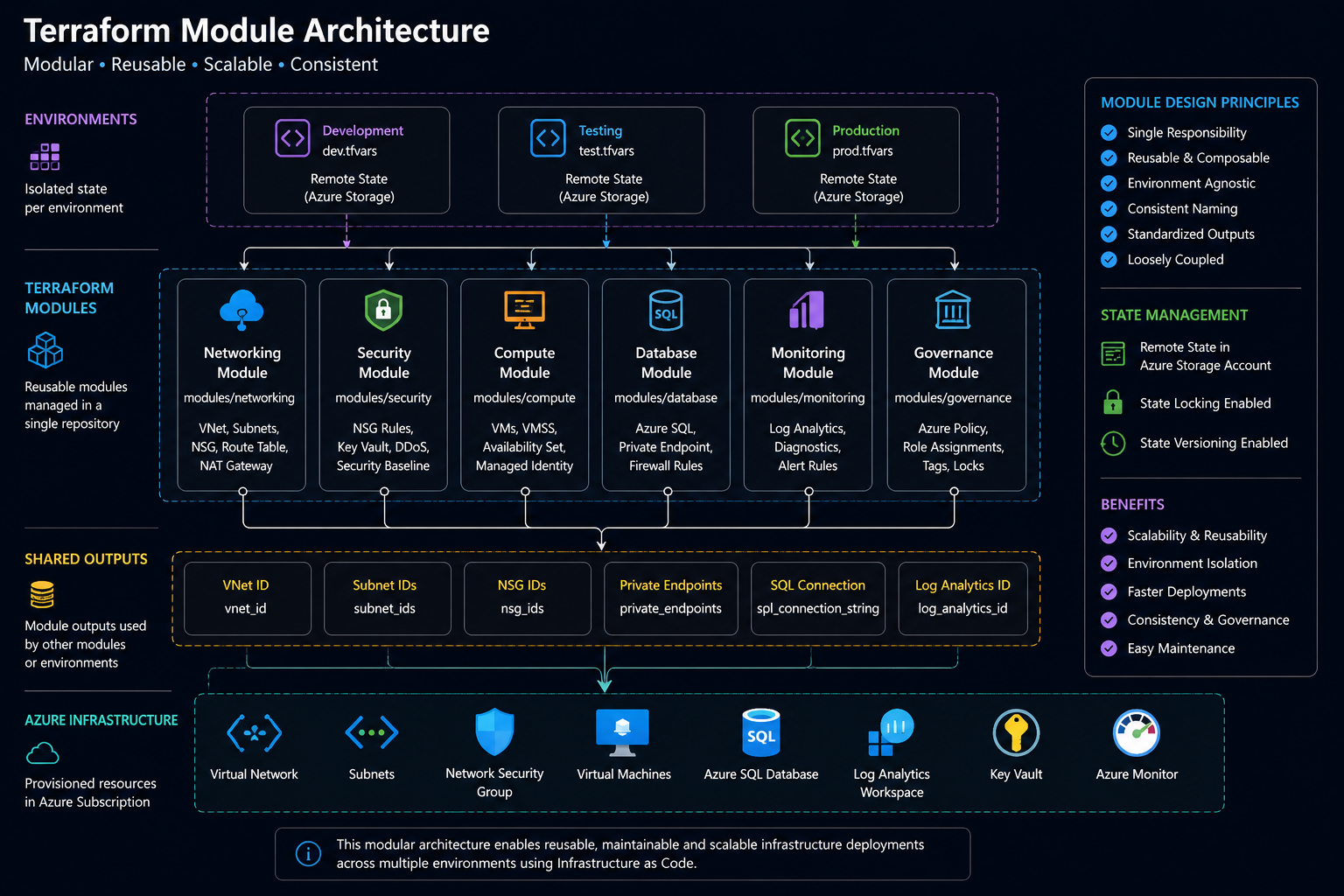
Infrastructure components were abstracted into reusable modules, enabling centralized governance, repeatable deployments, and environment-specific customization.
Repository Organization
modules/
├── networking/
├── security/
├── compute/
├── database/
├── monitoring/
└── governance/

environments/
├── dev/
├── test/
└── prod/

policies/
docs/
diagrams/
Infrastructure was organized using domain-based modules and isolated environments to improve scalability, governance, and operational consistency.
Modular Design Strategy
Core Infrastructure Modules
Infrastructure concerns were separated into reusable modules such as network, security, and compute layers.
Environment Separation
Environment-specific variables enabled deployment isolation across dev, test, and production.
Standardized Interfaces
Variables and outputs were standardized to simplify module consumption and scalability.
Implementation Example
Example of a reusable Terraform network module enabling consistent infrastructure deployment.
module "network" {
  source              = "../modules/network"

  resource_group_name = var.resource_group_name
  location            = var.location

  vnet_name           = "vnet-hub"
  address_space       = ["10.0.0.0/16"]
}
Reusability
Same module deployed consistently across environments.
Parameterization
Flexible deployment through standardized inputs.
Scalability
Enables rapid expansion without infrastructure duplication.
Security as Code
Security policies were embedded directly into infrastructure deployment workflows.
resource "azurerm_network_security_group" "nsg" {

  name                = "nsg-hub"
  location            = var.location
  resource_group_name = var.resource_group_name

  security_rule {
    name                       = "Allow-HTTPS"
    priority                   = 100
    direction                  = "Inbound"
    access                     = "Allow"
    protocol                   = "Tcp"

    destination_port_range     = "443"
    source_address_prefix      = "*"
    destination_address_prefix = "*"
  }
}
Security Enforcement
Security controls deployed consistently through code.
Auditability
Infrastructure changes fully traceable through version control.
Governance
Standardized security posture across deployments.
Architecture Decisions
- • Modular design for reusability and maintainability
- • Environment isolation for operational reliability
- • State separation to reduce deployment risk
- • Parameter-driven deployments for flexibility
Trade-offs & Considerations
- • Higher initial architecture complexity
- • Learning curve for module adoption
- • Ongoing module version management requirements
Future Enhancements
- • CI/CD pipeline integration
- • Policy-as-Code enforcement
- • Cost governance automation
- • Advanced module versioning strategy
Deployment Validation
The infrastructure was successfully deployed and validated using modular Terraform workflows, environment isolation, reusable infrastructure components, and automated deployment processes.
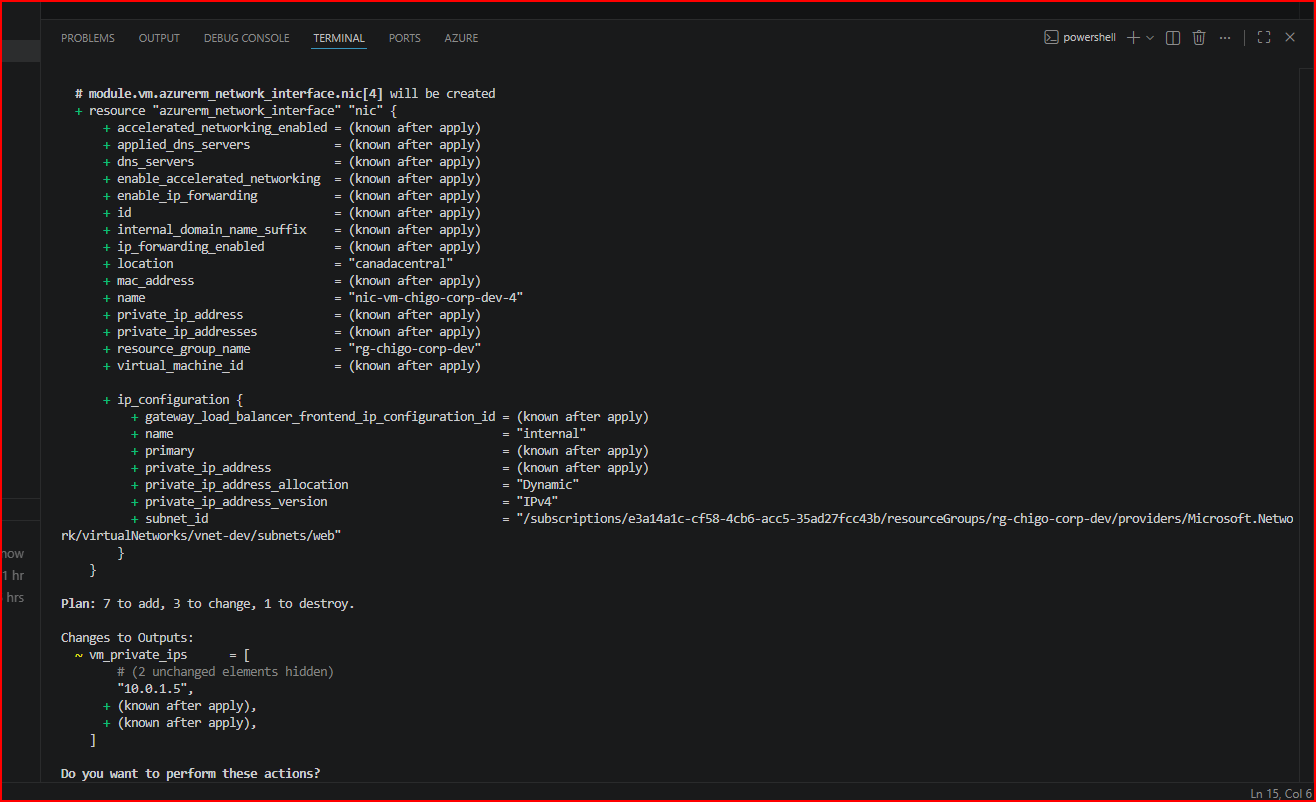
Terraform Apply Execution
Successful infrastructure provisioning and orchestration using reusable Terraform modules, environment segregation, and infrastructure-as-code deployment pipelines.
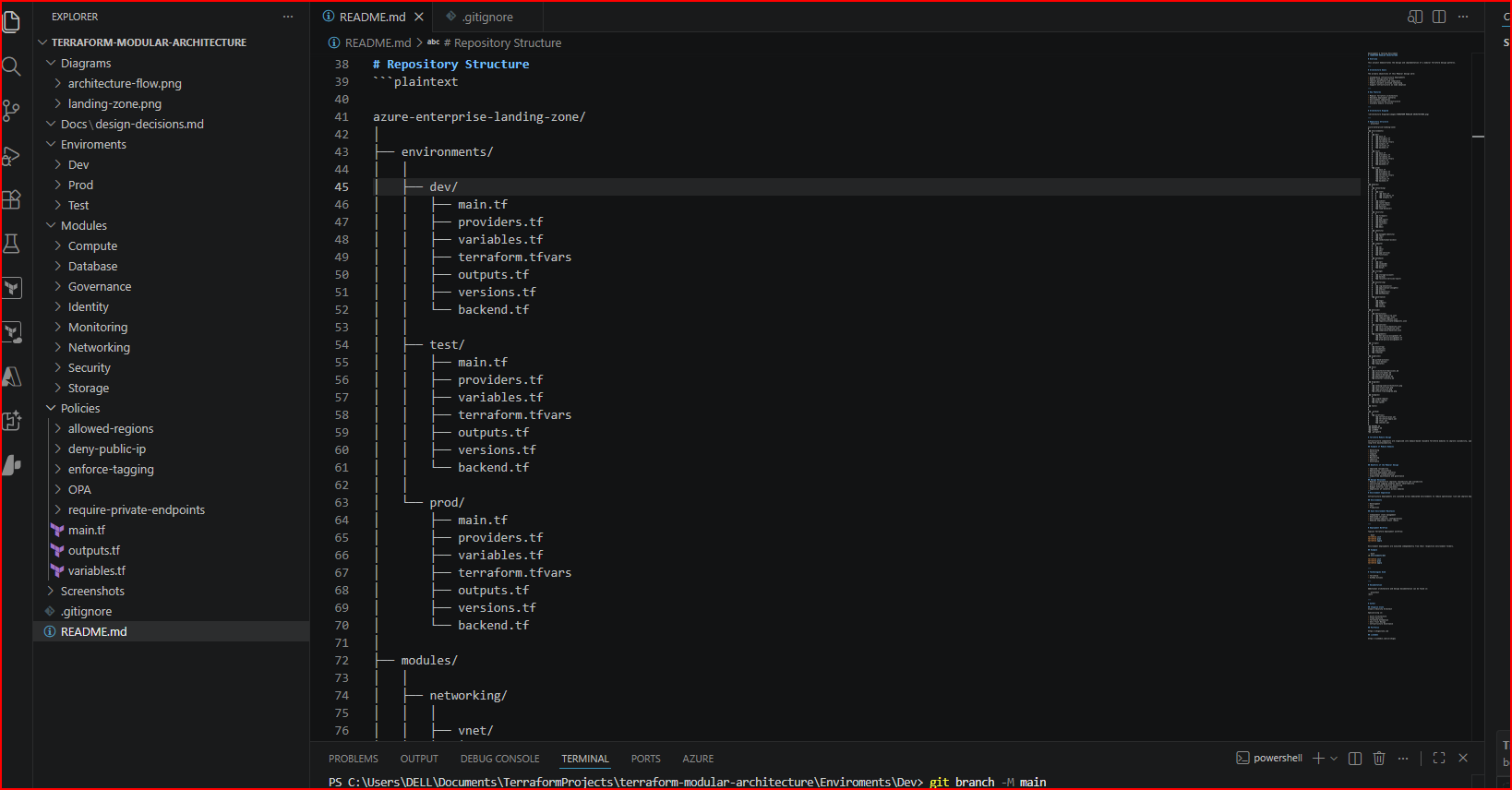
Modular Repository Structure
Domain-based Terraform module architecture designed for scalability, operational consistency, governance enforcement, and long-term maintainability.