Zero Trust Architecture Implementation
Designed and implemented a Zero Trust security architecture focused on identity-first access, continuous verification, segmentation, and attack surface reduction across cloud environments.
Executive Summary
Implemented a Zero Trust security model that eliminated implicit trust, enforced least privilege access, improved visibility, and reduced lateral movement risks through layered security controls and centralized monitoring.
Business Context
As cloud adoption increased, traditional perimeter-based security models became insufficient. The organization required a modern security architecture capable of protecting distributed workloads, users, and services across cloud environments.
Security Impact
Reduced Attack Surface
Eliminated unnecessary public exposure using private connectivity and segmentation.
Lateral Movement Prevention
Restricted east-west traffic and workload communication paths.
Identity Enforcement
Enforced least privilege access with MFA and conditional access policies.
Improved Visibility
Centralized logging and monitoring improved detection capabilities.
Threat Model
- • Lateral movement across flat network architectures
- • Unauthorized access through compromised credentials
- • Public exposure of sensitive services
- • Limited visibility into user and workload behavior
Zero Trust Approach
Identity-First Security
Every access request required authentication, authorization, and contextual verification before access was granted.
Continuous Verification
Access decisions were continuously evaluated using user identity, device posture, session behavior, and contextual risk.
Assume Breach
Network segmentation and least privilege controls were designed to minimize blast radius in the event of compromise.
Zero Trust Architecture
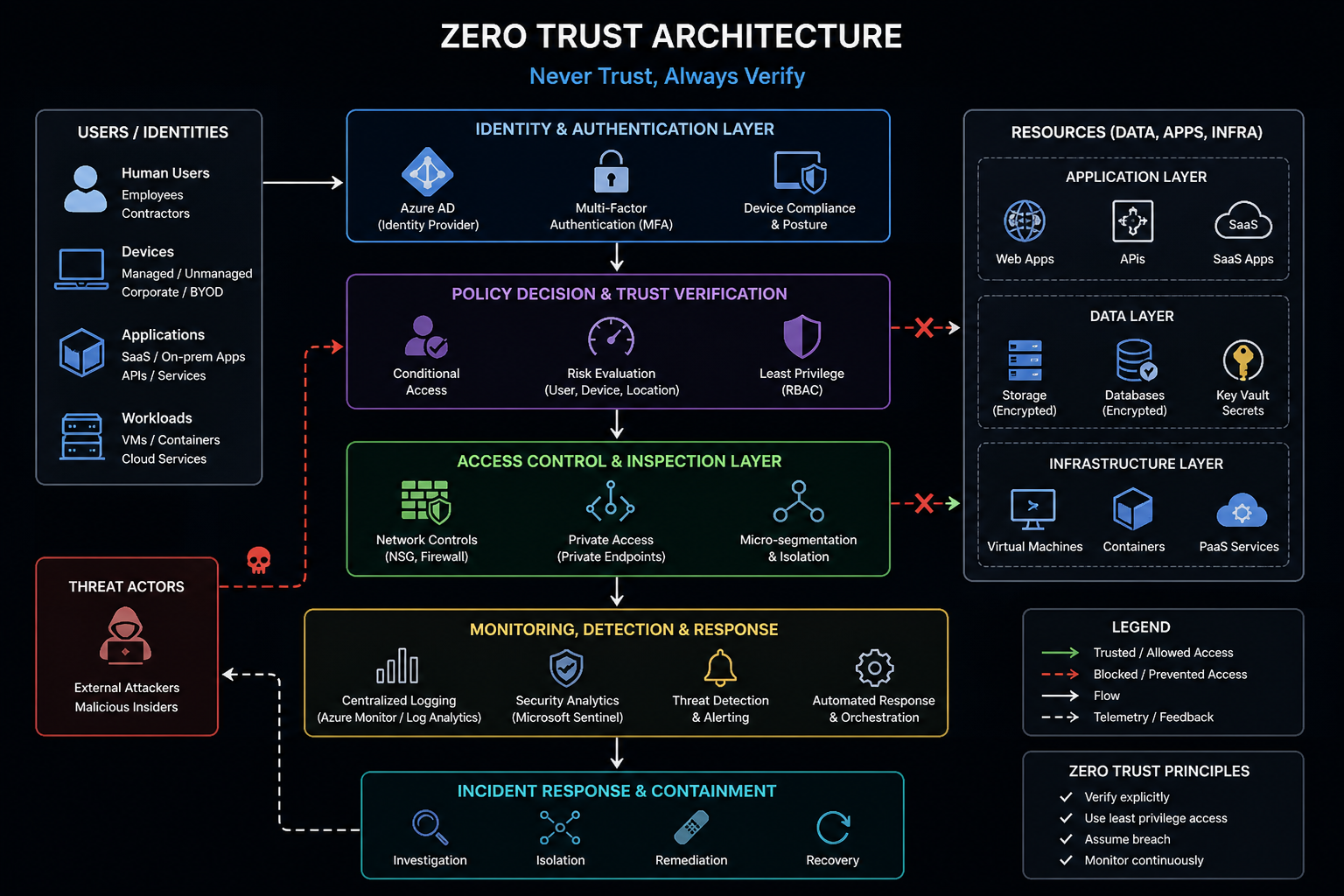
The architecture enforces verification at every layer, ensuring users, devices, and workloads must be explicitly validated before access is permitted.
Access Flow
- User attempts to access application or service
- Identity verified via Azure AD with MFA enforcement
- Conditional access policies evaluated
- RBAC policies determine least privilege access
- Traffic routed through controlled network paths
- Activity logged and continuously monitored
Zero Trust Control Layers
Identity
Azure AD, MFA, RBAC, Conditional Access
Device
Device posture and compliance validation
Network
Segmentation, NSGs, private endpoints
Monitoring
Logging, alerts, Defender for Cloud
Attack Simulation Scenarios
Scenario 1 — Compromised User Credentials
• MFA prevents access using credentials alone
• Conditional access policies evaluate risk context
• RBAC limits access scope
• Monitoring detects suspicious activity
Outcome: Attacker unable to gain meaningful access or move laterally.
Scenario 2 — Compromised Workload
• Segmentation restricts east-west traffic
• Private endpoints reduce exposure
• NSGs isolate workloads
• Monitoring detects abnormal communication patterns
Outcome: Compromise contained within isolated workload boundary.
Security Maturity Alignment
- • Aligns with Zero Trust principles (verify explicitly, least privilege, assume breach)
- • Supports NIST Zero Trust Architecture guidance
- • Enables continuous monitoring and adaptive access control
Architecture Decisions
- • Identity-first security model adoption
- • Elimination of public endpoints where possible
- • Centralized monitoring and inspection strategy
- • Segmentation-first network design
Trade-offs & Considerations
- • Increased operational complexity
- • Additional authentication friction for users
- • Greater policy management overhead
Future Enhancements
- • Advanced SIEM integration
- • Risk-based adaptive access policies
- • Expanded device compliance automation
- • AI-assisted threat detection workflows
This architecture assumes breach by default, ensuring trust is continuously validated across identities, devices, and workloads.